Black August in the Age of Billionaires
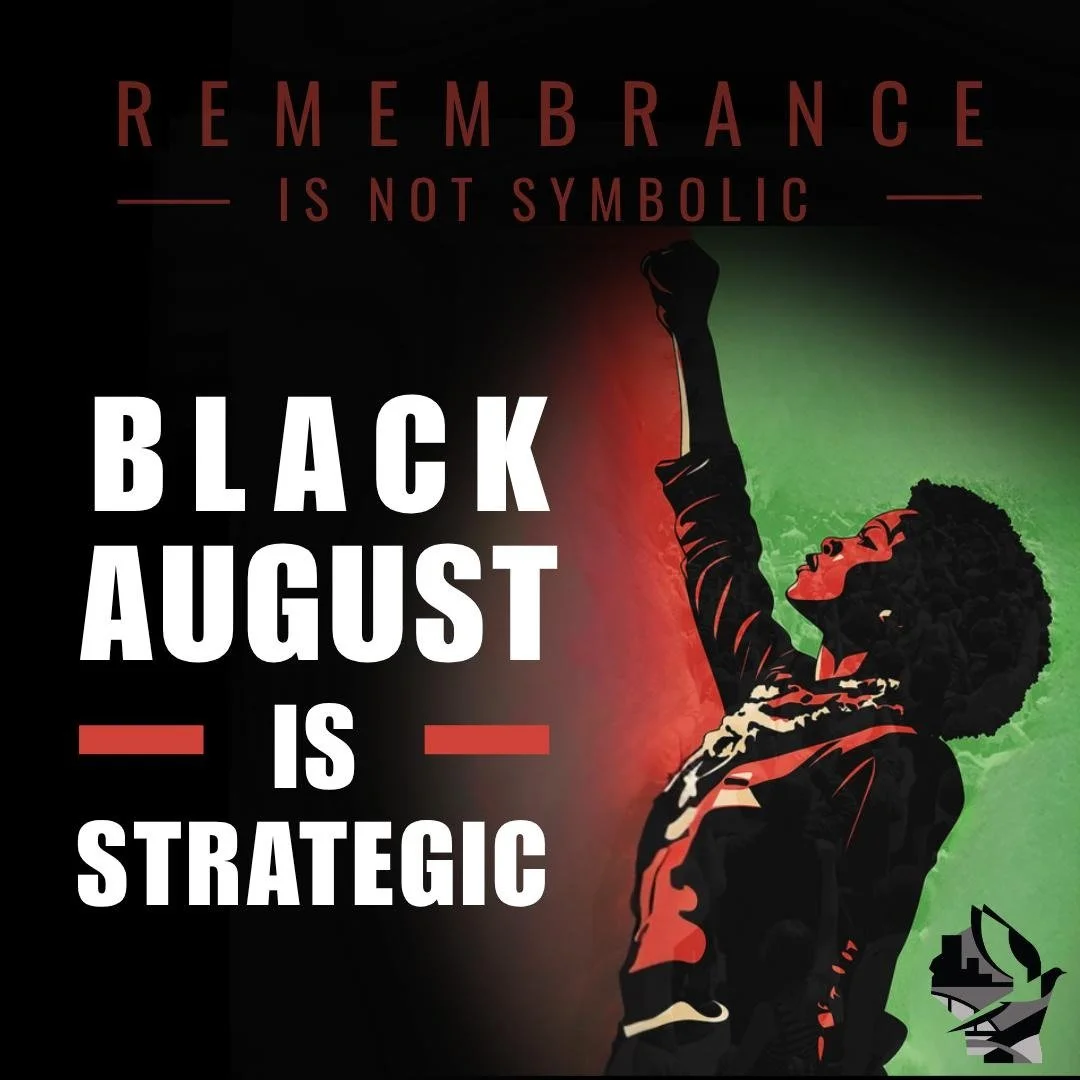
Black August is a call to study the architecture of oppression. To be serious about liberation, we cannot honor our liberation without confronting the systems designed to keep us in bondage. So let’s get into it.
Black August is a celebration of resistance and of Black people's refusal to accept a world built on our backs and at our expense. It is also a month to study the systems that cage us, starve us, surveil us and then call that violence lawful. This isn’t just about resistance but about our lineage and the continuation of an unstoppable tradition of perseverance, which must be acknowledged not only in August but in every moment and at every intersection of our history.
Originating in California prisons to honor George Jackson and other fallen revolutionaries, Black August is an annual observance that commemorates Black freedom struggles, political prisoners, and ongoing resistance to systemic oppression. George Jackson, Assata Shakur, Angela Davis, to name a few, were figures that shaped the Black Power, prison abolition, and civil rights movements of the 60s and 70s.
The extractive systems that Black August teaches us to confront, which targeted these political activists, were never dismantled; they have evolved. They have been redesigned, repackaged and expanded. Today, billionaire power shapes our lives and the political landscape with an audaciousness that threatens our democracy, dignity and the future of our communities. Their wealth buys influence, rewrites policy, and starves the public sector, all while everyday people are told to tighten their belts and do more with less.
No, seriously, let’s talk about it.
Black August is not symbolic, but strategic. It demands that we look directly at the ever-evolving machinery of oppression.
What did George Jackson teach us?
George Jackson taught us that prisons function as tools of racist and capitalist oppression, but that captivity shouldn’t stop the drive to study, organize, and fight for collective liberation.
While others may debate my analysis, George Jackson held two core beliefs that we can still learn from today.
Study
Not just surface-level studying, but deep study. He spent years in solitary confinement reading economics, philosophy, and revolutionary theory.
Part of his study included sharing his knowledge. He famously wrote letters that were published in Soledad Brother, which showed others how to build political awareness from inside a cage.
Organize
Organize, organize, organize! Collective power was a cornerstone of George Jackson’s methods for building unity. He proved that ordinary people can organize against extreme state control.
We have to be willing to fight! Imagine being behind bars and still teaching prisoners about structural inequality and self-defense.
Jackson's impact has lasted more than 50 years. His work exposed harsh prison conditions and inspired generations of activists to demand human rights everywhere.
“As a slave, the social phenomenon that engages my whole consciousness is, of course, revolution. Revolution should be love inspired.” — George Jackson, Blood in My Eye.
The systems George Jackson and our ancestral leaders worked to dismantle didn’t disappear; they migrated into a machine so effective that we question the truth and not the lie. The fight of yesterday’s Black August movement has always included boardrooms, coordinated political networks, and a continuation of state-sanctioned violence. Today, the architecture of extraction and distraction is maintained by a billionaire class whose wealth shapes our public and private lives, in our elections, our schools, our land and our narratives. And it is done blatantly in full view, and often not only without public scrutiny but is celebrated.
The Prison-Industrial Complex
Billionaires and multibillion-dollar investment firms have heavily shaped the prison-industrial complex through private equity ownership, lobbying, and profit-driven services. They profit from “slave” labor.
Corporations like GEO Group and CoreCivic operate multiple private prisons and immigration detention centers in the United States.
Large asset management firms, such as Vanguard and BlackRock, hold major shares in these private prison companies.
These companies charge families high rates for phone calls, video visits, and emails to incarcerated loved ones.
Private vendors sell basic food, hygiene items, and clothing inside prisons at steep markups. Additionally, they charge high fees just to put money on an incarcerated individual's books.
Incarcerated individuals often work for pennies an hour, or sometimes for no pay at all, to make products or provide services.
Private and state-run factories use this cheap labor to produce goods such as office furniture, clothing, and electronics.
Incarcerated workers are usually excluded from federal minimum wage laws and labor unions.
Prison companies spend millions of dollars on political campaigns and lobbying.
They have historically pushed for tougher sentencing laws and immigration policies to keep prison populations high.
Sources: https://www.brennancenter.org/https://www.npr.org/)
The Work of Black August Continues
The discipline of Black August can involve study, fasting, training and collective action, which was never meant to stay inside prison walls. It was meant to guide us as we confront every iteration of the systems that harm us. And in 2026, one of those iterations is billionaire dominance in Wisconsin.
But Black August is not only about naming harm. It is about building the discipline required to transform it.
It calls us to sharpen our analysis of how wealth moves through Wisconsin. It calls for us to strengthen our organizing. It calls for us to deepen our narrative power, so communities understand who is shaping our conditions and why. It calls on us to reject scarcity mindsets that tell us to expect less, settle for less, or fight over crumbs.
Black August is another reminder that joy is not a distraction from the struggle or the work, but the fuel for it. Of course, joy alone cannot counter the scale of extraction Black people face. But we have the blueprint for the discipline, clarity, and collective courage that it will take to overcome.
Wisconsin Is a Battleground
In Wisconsin, honoring Black August can start with the following:
Name the systems harming our communities, including and especially billionaire influence.
Build coalitions that refuse to be divided by misinformation, disinformation, fear, hate or a scarcity mindset.
Work to strengthen public institutions rather than surrender them to private interests.
Invest in narrative power that tells the truth about who benefits from extraction and who pays the price.
Stay in Practice! The discipline of Black August demands study, strategy, solidarity, and sustained action.
We owe it to each other, our ancestors, our communities, and our future to meet this moment with clarity and fire.
If Black August teaches us nothing else, let it teach us that this struggle continues, and so does our commitment to win, for our people.